|
Designing
a solar power system
Photovoltaic
Cells and Modules 
The
solar module (or photovoltaic component of the system) is
the heart of the system. It transforms the sun's rays into
useable electrical energy.
The solar module (or panel) is comprised of several individual
photovoltaic cells connected in series or parallel with a
metallic material. The energy produced by a solar module is
influenced primarily by the number of cells within a module
and how these cells are arranged within
the module. When the cells are connected in series, the total
voltage is the sum of the voltages from each individual cell.
The output current in this configuration will remain the same
as that produced from a single cell. When the cells are connected
in parallel, the total current is the sum of the currents
from the individual cells and the output voltage is the same
as that produced from a single cell. Each cell in a module
typically produces anywhere from 2 to 5 amperes and approximately
0.5 volts (about the same amount as produced from an ordinary
flashlight battery). The cells can be arranged in a module
to produce a specific voltage and a specific current to meet
your electrical requirements. By multiplying the output voltage
by the output current, one can calculate the total electricity
produced (in watts). Typically, cells are arranged in a module
to produce voltages in increments of 12. Hence, most modules
in the marketplace are 12 volts, 24 volts, and even 36 volts.
The trend is to higher voltage modules.
Like photovoltaic cells, solar modules can also be arranged
to produce a specific current and voltage. By connecting solar
panels in certain configurations (called a solar array), one
can dictate the current and voltage of the array, thus dictating
the electricity the system produces.
The size of your photovoltaic system will be dictated by the
amount of daily energy required (loads) and the amount of
energy available at your location. A professional supplier
can assist you by performing a detailed analysis and preparing
a quotation based on the analysis. Using energy efficiently
will reduce the cost of your system.
Module
Types
Modules
are available in different power outputs, frame types, cell
technology, life expectancy and efficiency. These factors
will determine the best panel to suit your needs. BP Solar
has a wide range of high efficiency solar modules to suit
virtually every application.
For information on specific BP Solar modules, click here.
Module
Colors
Modules
can be produced in various colors. This is typically associated
with the need to create a distinctive look either for security
reasons or for architectural reasons. However, producing modules
in a certain color is a custom production effort and requires
a volume order in excess of 50,000+ cells for any given color.
This also requires extensive lead times to complete the work
and additional costs would be included for engineering development
and manufacturing adjustments. The typical cost for adding
color to cells is 2 to 3 times the price of normal cells (per
cell). The color will also result in a degradation of performance
over normal cells of about 20%.
How
PV Modules Efficiencies are rated in the Factory
PV
modules are rated at a well- defined set of conditions known
as Standard Test Conditions (STC). These conditions include
the temperature of the PV cells (25 C or 77 F.), the intensity
of radiation (1 kW/square meter), and the spectral distribution
of the light (air mass 1.5 or AM 1.5, which is the spectrum
of sunlight that has been filtered by passing through 1.5
thicknesses of the earth's atmosphere). These conditions correspond
to noon on a clear sunny day with the sun about 60 degrees
above the horizon, the PV module directly facing the sun,
and an air temperature of 0 C (32 F). In production, PV modules
are tested in a chamber known as a flash simulator. This device
contains a flash bulb and filter designed to mimic sunlight
as closely as possible. It is accurate within about 3.1%.
Because the flash takes place in only 50 milliseconds, the
cells do not heat up appreciably. This allows the electrical
characteristics of the module to be measured at a single temperature,
the ambient temperature of the module/factory. Since this
temperature is usually close to 25 C, a minor adjustment corrects
output characteristics to the 25-degree standard temperature.
Approximate Energy Efficiency Ranges
for Various Module Types
| Cell Type |
Efficiency Range |
| Monocrystalline cells |
14 to 16% |
| Polycrystalline cells |
13 to 15% |
| High efficiency monocrystalline cells
(BP Solar Saturn cells) |
approximately 16.5% |
Does
PV Work in the Cold?
Yes,
very well in fact. Contrary to most people’s intuition, PVs
actually generate more power at lower temperatures, other
factors being equal. This is because PVs are really electronic
devices and generate electricity from light, not heat. Like
most electronic devices, PVs operate more efficiently at cooler
temperature. In temperature climates, PVs will generate less
energy in the winter than in the summer, but this is due to
the shorter days, lower sun angles and greater cloud cover,
not the cooler temperatures.
Does
It Work In Cloudy Weather?
PVs
do generate electricity in cloudy weather although their output
is diminished. In general, the output varies linearly down
to about 10% of the normal full sun intensity. Since flat
plate PVs respond to a 180-degree window, they do not
need direct sun and can even generate 50-70% of their rated
output under a bright overcast. A dark overcast might correspond
to only 5-10% of full sun intensity, so output could be diminished
proportionately. Indoor light levels, even in a bright office
are dramatically lower than outdoor light levels, typically
by a factor of several hundred or more. PVs designed for outdoor
use will generally not produce useful power at these light
levels since they are optimized for much higher intensities.
On the other hand, PVs designed for lower light levels like
the cells found on calculators are optimized for those conditions
and perform poorly in full sunlight.
Aside
From PV Modules, What Else Do I Need In My PV System?
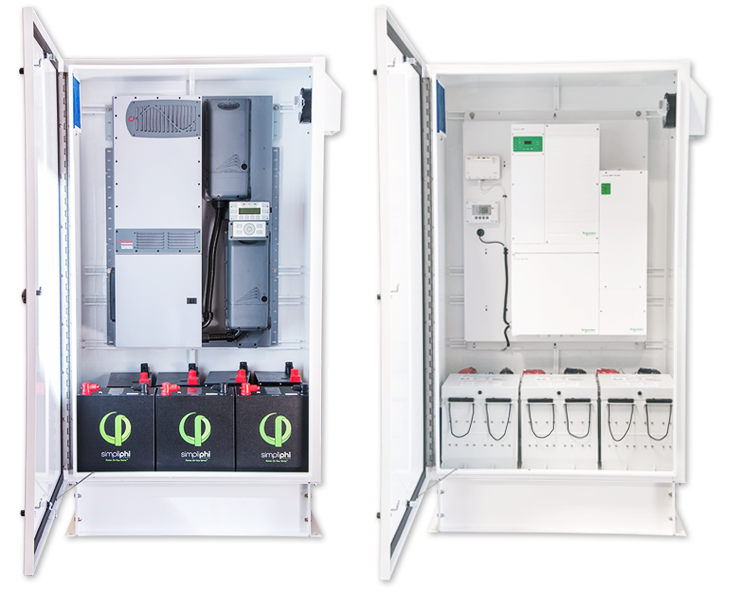
Although
a PV system can be as simple as a module and a load (such
as a direct driven fan), most PV systems are designed to supply
power whenever it is needed and so must include batteries
to store the energy generated by the PV array. Systems with
batteries also need electronic devices to control their charging
or limit the discharging of the batteries. Since PVs and batteries
are inherently DC devices, large systems usually include DC/AC
inverters to supply AC power in standard voltages and frequencies.
This enables the use of standard appliances in the system.
Otherwise special DC appliances (usually from the RV or marine
industry) must be used. On the electrical side, protective
devices such as diodes, fuses, circuit breakers, safety switches
and grounds are required to meet electric code safety standards.
In general, PV systems also require mounting hardware to support
and elevate the PV modules and wiring to connect the PV modules
and other components together.
Will
Tracking Improve The Performance Of My System? How About Using
Reflectors To Concentrate More Light On The Modules?
The
effectiveness of tracking depends a lot on the climate and
the application. Areas with a lot of haze or clouds won’t
get much benefit from trackers because the light is scattered.
Also, applications where the load is the same in every month
will also derive little benefit because tracking doesn’t improve
the performance of the system very much under worst case (usually
winter) conditions. Under ideal conditions, trackers improve
PV output per day up to 40% but they add to system complexity
and expense and are not generally as strong as fixed mounting
systems. Their use is generally limited to applications where
the increased output matches increased demand (such as livestock
watering) in drier areas (i.e., the US Southwest).
Reflectors
can increase the output of PV arrays somewhat, although their
effect is not linear because the increased light intensity
causes the module to operate at higher temperatures, which
reduces its efficiency. More importantly, the elevated module
temperatures and light intensities can lead to premature failure
of the module, and for this reason, the use of artificial
ref lectors is not recommended and will in fact void the module’s
warranty.
How
Long Will My PV System Last? Do PV Modules Lose Power Over
Time?
In
general, the PV modules are the longest lived component of
a PV system. Top quality modules such as BP Solar’s MEGA series
are designed to last at least 30 years and carry a 20 year
warranty. They are designed to withstand all of the rigors
of the environment including arctic cold, desert heat, tropical
humidity, winds in excess of 125 mph ((200kph),), and 1 inch
(25 mm) hail at terminal velocity.
Batteries
will at best last about 7 years (high quality industrial types).
Smaller sealed units will typically last 3 to 5 years. Automotive
batteries are poorly matched to the characteristics of PV
systems and will generally only last 12 to 18 months in PV
service.
Some
types of PV modules (using thin film silicon) have a predictable
fall-off in output in the first few months of operation which
slows down and stops after some time. The modules’ output
from then on is relatively stable. This is a comparatively
small effect in current Solarex thin film modules which carry
an 80% power warranty for 5 years. Polycrystalline modules
such as BP Solar’s MEGA series do not experience this kind
of degradation and in fact are warranted to produce 80% of
their original minimum power rating for 20 years.
What
About Breakage? Don’t Most Modules Contain Glass?
The
most reliable, longest lived PV modules use a glass superstrate.
For Solarex’s MEGA series this is low iron-tempered glass
and is laminated with layers of plastics. This construction
is very durable but given a strong enough impact, it will
break. If the glass is shattered or punctured the module will
eventually fail due to water getting into the solar cells
and causing corrosion, It may take years for the module to
completely fail (produce no power). On the other hand, if
the module is damaged in such a way that the two electrical
connections between any given pair of cells are both severed
there will be no path for the current and the module will
have no output.
BP Solar
makes a series of products called Life modules which use an
aluminum substrate rather than a glass superstrate. These
modules are designed for light weight and ruggedness in applications
such as camping and are shatterproof. In a permanent installation
however, they will not last as long as equivalent glass front
modules. This is because the plastic covering used is not
as inert as glass and the aluminum is not as good a match
(for thermal expansion) as glass is to the silicon solar cells.
In
summary, given enough force anything will break. The most
effective protection against vandalism, theft and other catastrophes
is property/casualty insurance.
What
Should I Look For When Purchasing A PV Module?
An
informed buyer will look at a number of items when buying
a PV module. First, ask the seller what external agencies
have tested, qualified, or otherwise approved the module.
In the US, look for a listing from Underwriters Laboratories
(UL) and Factory Mutual Research (FM), organizations which
certify the safety and performance of PV products. In Europe
look for approval by the Commission of the European Communities
(CEC). Ask if the module passes the tests established by the
US Jet Propulsion Laboratory (JPL Block V) to verify long-term
reliability. Find out if the manufacturer regularly qualifies
production units (rather than laboratory samples) to international
standards.
Next
check out the module. Pick it up. Does it have a solid feel?
Or does the frame easily twist. Look at the junction box.
Is it solidly attached? Can it accommodate standard electrical
fittings? Can it take heavy gauge wire? Can connections between
modules be made in the box? Will it accommodate diodes and
regulators if needed?
Look
at the solar cells. Are they perilously close to the module
frame (which can lead to electrical breakdown and premature
failure)? Are the module bus bars open and well isolated or
are they folded behind the cells where they can cause electrical
shorts or delamination?
Study
the label. Is the actual tested power of that individual module
printed on the back, or is there only a generic label? If
so, is it clear what the manufacturer’s tolerance is on power
(how far below nominal can the power be and the module still
be considered within specifications)? Ask the seller if it
is not readily apparent. Does the module have enough voltage
to charge batteries under all conditions (at least 16.5 volts
at maximum power)?
Examine
the warranty. Is it vague or does it guarantee a specific
level of performance?
Finally,
look at the manufacturer. How long have they been manufacturing
photovoltaics? Are they an organization likely to still be
in business in 10 years? What is their reputation? Have their
products proven reliable in many years of operation? Do they
have a trained sales force and authorized distributor team
to back up their products in the field?
We
at Southwest PV Systems invite you to put us to the test.
We are confident that you will find our BP Solar photovoltaic
modules and systems to be the best in the industry and we
hope that the information in this catalog will help you to
make PV part of your life.
|